Quiñones and Jiménez send the Azteca into rapture as Mexico open the World Cup in style
- In a ceremony worthy of the occasion and a match that finished with two red cards for Bafana Bafana and one for the hosts, Mexico launched the biggest World Cup in history with a dominant 2–0 victory that will echo from Tijuana to Cancún
FIFA WORLD CUP 2026 · GROUP A · ESTADIO AZTECA | |||
| |||
| ⚽ Quiñones 9' — Opening goal of the tournament ⚽ Jiménez 67' — Header, assisted R. Alvarado 🟥 Sithole 50' · Zwane 84' — South Africa (two red cards) 🟥 C. Montes 90+2' — Mexico (one red card) |
There is a moment in the opening ceremony of every World Cup — a tipping point between spectacle and sport, between the rehearsed and the real — when the crowd seems to collectively agree that something historic is afoot. At the Estadio Azteca on Thursday, that moment arrived at 11.53 local time, somewhere inside Shakira's performance of "Dai Dai" with Nigerian superstar Burna Boy, when 80,000 voices in green, white and red seemed to simply swallow the stadium whole.
The festivities had begun with a dance routine paying tribute to Aztec culture, before Mexican rock legends Maná took the stage to perform "Oye Mi Amor" — a song that seemed to have been written specifically for this thunderous setting. Colombian singer J Balvin arrived on what appeared to be a papier-mâché car, while Danny Ocean and Los Ángeles Azules, accompanied by traditional Ballet Folklórico dancers, filled the stadium with music that moved between centuries, a reminder that this tournament was being held in a country of extraordinary cultural depth.
Shakira, dressed in a bright yellow sporty outfit carrying an easy echo of Colombia, looked every bit the star as she and Burna Boy closed the ceremony. Sixteen years after Waka Waka became one of football's defining tournament songs, the Colombian icon returned to the centre stage of a World Cup opening ceremony, and whatever the critics say about "Dai Dai" being better suited to studio recording than live performance, in the bowl of the Azteca it raised the hairs on every neck in the building. When the flags of all 48 nations unfurled — and reportedly the United States flag was met with a rather pointed chorus of boos from the home crowd — the ceremony had done its work. The World Cup was here.
What followed was a match that delivered on the occasion's promise, at least in terms of drama, even if the quality was at times more functional than festival. Mexico won the opening game of the 2026 World Cup, easing past South Africa at a raucous Estadio Azteca. But ease is perhaps too gentle a word for a contest that would ultimately feature three red cards and enough controversy to fuel Mexican sports radio for the rest of the summer.
Javier Aguirre's side took less than five minutes to create the game's first chance amid an electric atmosphere. Israel Reyes whipped a cross in from the right, and Raúl Jiménez got power behind the bouncing ball, forcing Ronwen Williams to tip it around his post smartly. It was a warning the South African goalkeeper could only delay.
In the ninth minute, Erik Lira burgled the ball from Sphephelo Sithole, and Quiñones struck it through Williams' legs from just inside the box. The Azteca erupted. Quiñones' strike is Mexico's earliest goal in a World Cup game since Rafael Márquez against Argentina in 2006, and also the earliest in any World Cup opening match since Philipp Lahm's strike for Germany against Costa Rica in 2006. History duly noted, the stadium's decibel level refused to come down.
- "It was the first goal of my career at a World Cup. I cannot put into words what it means. The whole country — it was for all of them."
JULIÁN QUIÑONES, POST-MATCH
The Colombian-born winger, whose naturalisation as a Mexican citizen had attracted sniping when it was announced, silenced every doubt with one emphatic strike. He led all Mexico players in total shots (five) and successful dribbles (five), earning player of the match honours. If this tournament needed a breakout star in its first ninety minutes, Quiñones auditioned with full force.
South Africa, managed by the Belgian Hugo Broos, had prepared in Mexico and trained at altitude near Pachuca, a pragmatic choice that spoke to their professionalism. But they were outclassed in the opening period, and their indiscipline in the second would prove catastrophic. Midfielder Sphephelo Sithole received a red card in the 49th minute for denying a goal-scoring opportunity, bringing down Bryan Gutiérrez who had broken free after a lobbed pass. Referee Wilton Sampaio, the Brazilian appointed for this opening fixture, showed no hesitation. One of the tournament's most important rules — do not give away possession cheaply, do not give Javier Aguirre's press a free run — Sithole had violated both.
Down to ten men, South Africa regrouped with commendable spirit, and for a period of about fifteen minutes after the restart the Mexican crowd shifted from celebration to anxiety. The Green and Gold threatened from set pieces and a couple of diagonal balls from the industrious Aubrey Modiba drew sharp saves from Raúl Rangel. But the dam was always going to break.
In the 67th minute, veteran striker Raúl Jiménez scored the second goal off a free header at the back post from Roberto Alvarado's cross — his long-awaited World Cup moment. Jiménez headed home his first-ever World Cup goal to spark wild and emotional celebrations. The 33-year-old, who had returned from a catastrophic skull fracture suffered in 2020 to rebuild his career, lifted his arms to the sky and the Azteca embraced him like a returning son.
LINEUP RATING:
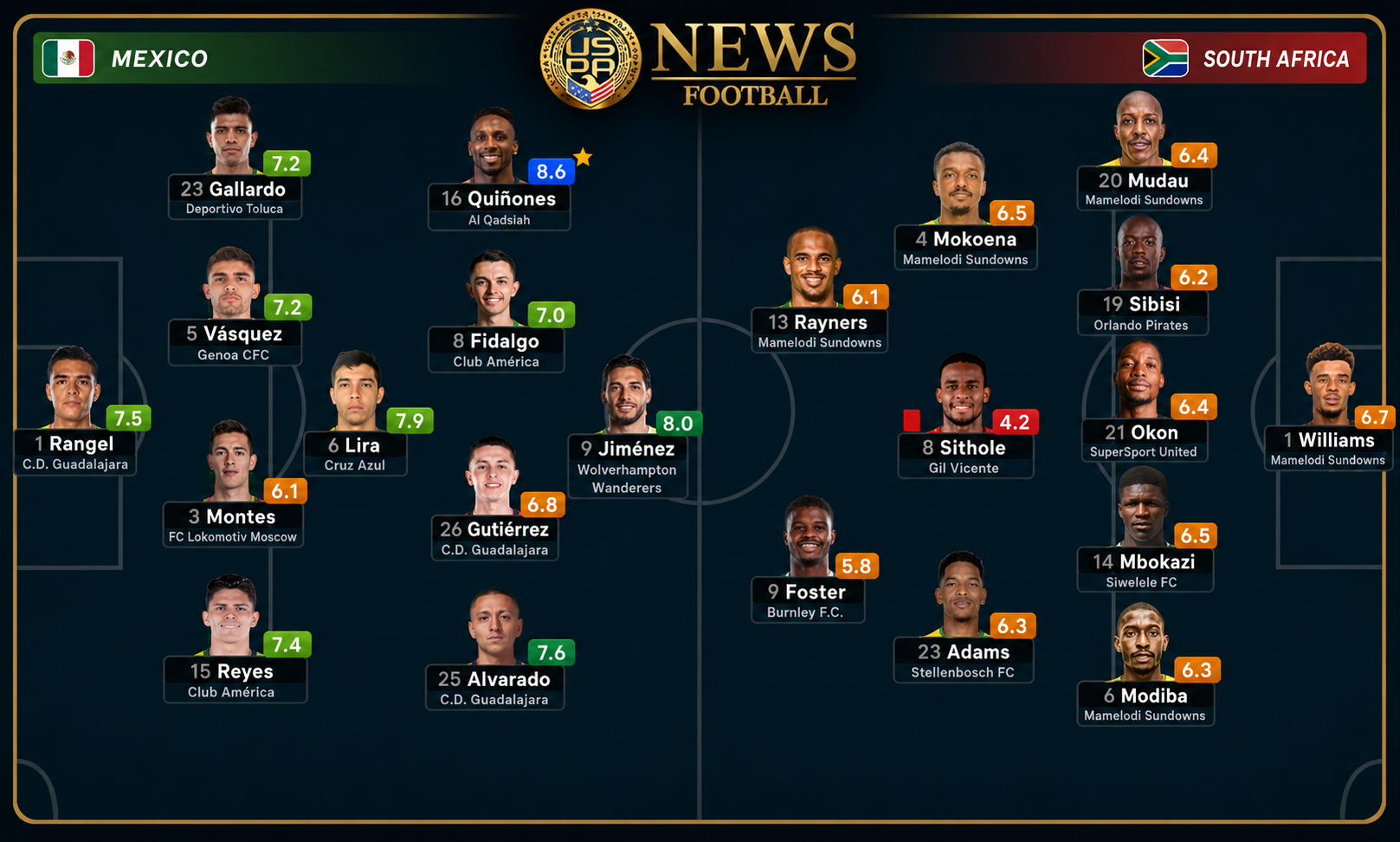
MATCH STATISTICS
| 🇲🇽 Mexico | MATCH STATISTICS | South Africa 🇿🇦 |
| 60.5% | Possession | 39.5% |
| 20 | Box touches | 2 |
| 7 | Shots on target | 4 |
| 467 | Passes completed | 272 |
| 1 | Red cards | 2 |
THE RED CARDS · A TOURNAMENT RECORD FOR AN OPENER
| 🟥 | Sphephelo Sithole (South Africa) — 50' Straight red: denied Bryan Gutiérrez a clear goal-scoring opportunity with a foul through on goal |
| 🟥 | Themba Zwane (South Africa) — 84' Red card for unsporting behaviour: struck Roberto Alvarado while contesting for the ball, VAR confirmed |
| 🟥 | César Montes (Mexico) — 90+2' Sent off for serious foul play; Mexico finished with ten men but with the result already secured |
Three red cards in the opening game of the 2026 tournament approaches the entire red card tally at the 2022 Qatar World Cup, where only four were shown across 64 games. South Africa became the first team to receive two red cards in a FIFA World Cup match since Portugal in 2006.
The final minutes descended into something between football and theatre. South Africa's Themba Zwane was dismissed — controversially, many felt — after VAR adjudged he had slapped Roberto Alvarado's face while contesting for the ball. Bafana Bafana were down to nine. Then, improbably, César Montes picked up a straight red for Mexico in injury time, meaning the hosts finished the most-watched match on earth with ten players. The final whistle provoked a collective sigh of relief from Javier Aguirre, whose expression throughout had cycled through pride, fury and barely-contained terror at roughly equal intervals.
There is, of course, a poetic symmetry to all of this. The 2010 World Cup — the first held on African soil — opened with hosts South Africa facing Mexico in that tournament's curtain-raiser, playing out a 1–1 draw. Siphiwe Tshabalala scored one of the great World Cup opening goals before Mexico's Rafael Márquez equalised. Sixteen years on, the roles are reversed: Mexico the host, South Africa the visitor, the same opening weekend energy but a very different result. Hugo Broos, who was working with Belgian club football in 2010, will take little comfort from the symmetry.
The Estadio Azteca becomes the first venue in history to host matches at three different men's World Cup tournaments, having staged games in 1970 and 1986. On those occasions it witnessed Pelé in his pomp and Diego Maradona's divine madness. On Thursday evening, it witnessed something different but no less moving: a footballing nation, carrying the weight of four consecutive group-stage exits, finally breathing again.
Mexico will be without key centre-back César Montes for their next group match, and South Africa will be missing two players. Mexico face South Korea in Guadalajara on Thursday 18 June. The tournament, all 104 games of it across three nations, has barely begun. But at the Azteca on a humid Thursday evening, with Shakira's anthem still echoing and Raúl Jiménez's arms still raised, the 2026 World Cup announced itself, loudly and unmistakably, as a tournament that intends to be remembered.
| TOURNAMENT CONTEXT The 2026 FIFA World Cup is the first to feature 48 teams (up from 32) and the first co-hosted by three nations: the United States, Mexico and Canada. It will run until 19 July 2026, featuring 104 matches across 16 venues in 11 cities. Mexico, South Korea and Czechia complete Group A. |